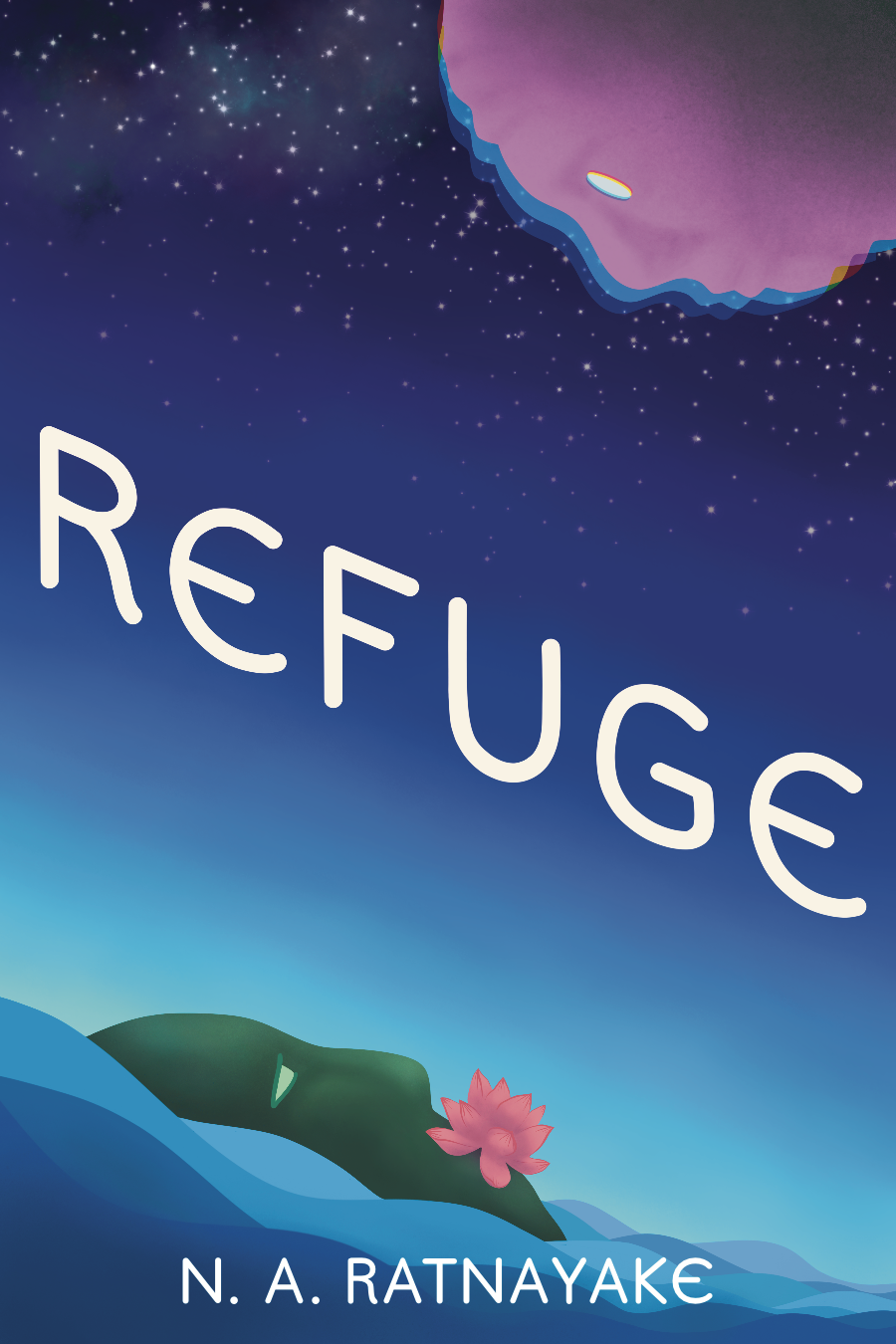
by N.A. Ratnayake
This short story originally appeared in the Redwood Writers 2024 Anthology: TRANSITIONS (Janice Rowley, Ed.), first printing 2024 by Redwood Writers Press.
Story written by and Copyright © 2024 Nalin A. Ratnayake. Edited by John Abbott.
Cover Art by and Copyright © 2025 by Riley Shea
All rights reserved by the creators. Permission to use for AI or LLM training is expressly denied.
“We are a way for the Universe to know itself.”
– Carl Sagan
In those days I had been an old man, having just come from Earth, because they love their old men—or at least, they assume old men are wise. In the form of countless advisors, gurus, swamis, wizards, viziers, pashas, and senators, I strove to pull them back from the brink of destroying their own planet. Over centuries of toil and millions of followers— young, old, men, women, and the range of humanity in between—I failed. I failed to trick them into saving themselves from themselves. And now I was tired.
Whenever I became depleted throughout the long stretches of time I worked on Earth, I found solace and replenishment in a quiet, rocky planet tucked away in a dormant corner of a lonely galaxy. I called it Refuge, because it lurked far from anyone or anything that might disturb it or me.
I named it to make it mine in a way, and to use it for my own ends. And in my hubris, I thought I was the only intelligence to sense Refuge, apprehend it, comprehend it, and name it. I knew of no other name by which it might be called, except the one I had given it. And because I found no one else who had named it before me, I assumed there was no intelligence there to do so.
I was wrong.
Refuge is replete with rivers. They start in the many highlands of the rugged mountains, which trap the moisture and hoard the uncountable plummeting snowflakes, which eventually melt and branch from the ridgelines. Trickles merging into rivulets merging into washes merging into streams and then finally mighty rivers, forever searching for the next tiny step downward, potential energy endlessly nosing out the direction of its own annihilation, an in-built craving for the end of gradient road, the inevitable merging with the whole.
The higher altitudes are edenic and lush with diverse scrub and forests. The waters journey through the lowlands downward to the deserts, where they thin and falter. There are no oceans. All rivers end exhausted and ephemeral in baking evaporative ovens of mid-latitude sands, their progeny vapor eventually beginning their descent anew in the snowy peaks.
This is the planet to which I retreated after quitting Earth, still as an old man because I was too tired to change into anything else. In the dry lowlands by a grove of what might on Earth have been called a willow, I sat regenerating on the banks of a thin stream where the living things were forced to cluster against the parch.
I listened to the trickle meandering around rock and root. I felt the presence of scurrying, small life grateful for the life-giving water, little pockets of sentience—able to observe but devoid of the ability to dream of mastering it all.
And isn’t that, after all, what we self-styled intelligent beings mean by intelligence? The capacity to make the false distinction that there is us and not-us, the propensity to dream and plan to make not-us serve us and our needs better than random chance, and the will and ability to put such manipulation into effect, even to our long-term peril as a species.
It was during these musings that the Beyul first reached out to me, though I did not know its name then or recognize that it had a name it called itself.
At first, I felt only sensations of plant-like being: The smell of gum tree and cedar after the rain, the yearning of a fern to unfurl in the sun, the dark questing of a thousand root tendrils slowly worming over hours into the soft loam, seeking water, water, always more water. I dismissed these sensations as products of my wandering mind. A thought-form, an idea-shape, an artifact of meditation while ruffled—no more.
But the Beyul was persistent against my prejudice.
A thirst grew in me, which I began to recognize as originating outside of me. A simple sensation spreading to dry mouth, cracked lips. Something was wrong. A pain, a yearning, a plea. I understood it then, though we had no language in common.
Now, a being can need help and not be intelligent. Does the parched seagrass on Earth, once resplendent in wetland flourish, understand that unseasonal drought erodes its home to nothing? Can each blade comprehend the treason of another species in the web of life borrowing against the future of all and leaving behind the bill? Is the suffering of the seagrass any less because it cannot name itself in a language we intelligent creatures understand?
And yet, by degrees, my curiosity led me down paths that parted my prejudice.
I welcomed the Beyul into my mind and followed its life essence where it led me. I saw that it was not merely the plants, the river, the rocks. As a being, it was emergent—a result of the connections made by this strand of the river, the particular flow of the water through the roots of a hundred different flora, the passing of their life energy into seeds and flowers and nectar. Its interaction with the world rested in the subtle manipulation—intentional, I at length had to concede—of the small animals which consumed its fruits, and the shaping of the land around itself to better assure its survival.
What is intention? Does the cockroach envision its next meal or scheme the best stratagem for gaining entry to the next domicile? Is not “follow this molecular trail wherever you find it, and the universe will provide food” a form of plan? Is a coordinated reaction and directed action toward a pre-defined goal enough to be called intent?
I suspected then that the rivers of Refuge were more than a physical life force, but a low-level form of sentience. The flow of these rivers and their life energy from object to object made a system that was, in an emergent sense, alive, and by degrees I could begin to admit… conscious.
The waters by which I sat meditating had once been a mighty river, which had over time dried to a creek, and now traversed this soil as a mere stream. Parts of the Beyul now received a mere fraction of what it had grown to want and need. If the trend continued, the life energy of this bounded system would cease its ordered cycles and dissipate into the surrounding environment.
That is to say, the Beyul was dying—and knew it.
My hubris was cracking. I can dissemble, rationalize, and evade blame, like any good intelligent creature. I had been an old man then, remember. Perhaps in my age, I was stuck in my thinking; or as a man then, fell prey to the arrogance of men; or in my then-human form limited in some fundamental way to the constraints of their primate minds.
But these are excuses only, and I knew it, even then.
It is a hard thing to acknowledge another being as one’s equal; because if one acknowledges personhood in another, the natural consequence of such admission is that one’s moral sphere must extend to encompass the other. And that can become a complex, tiresome thing. If I had just spent centuries on Earth on the moral compunction of attempting to save its dominant sentient species from itself, should I not intervene here to save this one, this unique new being I had never encountered?
I am ashamed to say that my pride had as much to do with saying yes as my heart did. I had failed on Earth. Perhaps here was a chance at redemption, at saving another being from a changing world. And at least this time, the being I would be trying to save wasn’t actively trying to work against me.
I showed it all I had learned on Earth and countless other places of how to live in changing times, how a water-loving life form can learn to adapt to a drier land, to seek and acquire moisture from other sources, and to conserve carefully what it had. I taught its ground covers to sprawl and shade the soil. I hardened soft skins against the dry winds. I suffused the air with the scent of fruits to entice animals to gather in the water, in hopes that they would pay for their sustenance with their urine and blood as they decomposed, giving back water and seeding the next species to follow.
It took time, of course. But what is a century or two in the span of things? I had nowhere to be but there. By the end, I’m not sure what the Beyul and I had could be called a friendship. I think our minds are too different for my definition of that word. But we had an understanding, and I felt its gratitude.
It came to me on a whim, what was next to be done. I opened a door, as my kind is able to do, the kind of door that lets us traverse the heavens and avoid the burden of putting up with each other. It was the same door through which I had come to Refuge from Earth, and Earth was still there. Through the door, a hidden valley in the Himalayas opened before me, remote and secret, far from the most concentrated clusters of prying intelligent eyes.
The Beyul twitched, sensing the new planet. It quivered in my mind, awed, hesitant. I knew that it knew that this world I had given up on needed help. With a twinge of thanks and farewell, the Beyul willed itself through the door. It shouted its name in the way it knew how, and its name formed as Beyul to my mind.
I closed the door.
For the first time in a long time, I was alone on Refuge again, with only my thoughts and my names for things as company. I do not know where I will wander next, or in what form—but I am old and tired of being a tired old man and crave something new. Perhaps it’s best I give up helping and begin to learn again. After all, my supposed intelligence nearly missed a being that might yet complete what I started, in ways I cannot imagine. Maybe I have forgotten how to be humble before the vastness of the stars.
I still rue my failure on Earth. But it comforts me to know that, in the mountains at the top of the world on that planet I could not save, there are now humans who know the name Beyul. They speak of hidden valleys that are the last refuges on a dying Earth, of secret wells of being that hold out hope to reseed life and hope, when the moment is right.
It will take time, of course.